The inevitable respray
‘It’s déjà vu all over again!’
You get the old hack resprayed and you are reminded of that moment, many years ago, when it was ‘love at first sight’.
But we’ve been through a lot together.

Now for some tech-talk…
Bicycles and human beings have a lot in common. We both have moving parts that either break or wear out. I can probably hear you say: ‘tell me about it!’ You may have broken a bone, which is likely to be an arm, leg or collar bone if you are a cyclist. Some of your joints may have worn out, and you’ve had a hip or knee replacement.
Well, my Litespeed Ti has suffered similarly from progressive age and constant use. I recently picked it up from the ‘bike hospital’, having had most of its moving parts replaced. In fact, the only original bits left are the frame and two wheels (including handlebars and saddle, of course). I have known for months that the whole drivetrain was edging towards the precipice of no return, but the closure of my local bike shop during the pandemic prevented the ‘surgery’ being carried out. So I kept riding and riding, clocking up the miles during lockdown, keeping fingers crossed that the drivetrain wouldn’t suddenly collapse…..but it did. The early symptoms included an overstretched chain jumping on the razor-sharp teeth of the front chainwheel. Just like many of us, the old bike was getting ‘long in the tooth’. Still unable to get it booked in at my LBS, I found another (equally professional) business that could fit me in.

With the complete re-fit, I have taken the opportunity to revise the entire range of gear ratios, bringing everything down several inches. Most of my cycling life, I have ridden the standard range provided by the compact-double chainring of 50/34, coupled with an 11-30 cassette at the back, giving a range of approximately 120″-30″. A good range to have, and it has served me very well over the years. But, as is the way with all human beings, the anno domini have been marching on almost imperceptibly, until I realised one day I wasn’t climbing the local hills with quite the same ease I used to and, like a lot of male cyclists of my ilk, I was refusing to accept the inevitable. Until now….
So, the bottom line is, I have had fitted a 40/24 crankset, with an 11-32 cassette, now giving me a gear range of 96″-20″, which means that some of the bothersome hills have mysteriously flattened out. In fact, I climbed one this morning that would have had me in my lowest gear with the old set-up, and now I find I have 3 ratios to spare!
If you are not familiar with ‘gear inches’ (as opposed to gain ratios), on my old set-up, to engage with the top ratio of 120″, I would have to be going at more than 80kph. Given that I seldom exceed 50/60kph, the top four or five ratios were useless and dispensable. Now, with a top ratio of only 96″, I can still pedal at speeds over 50kph, but it now gives me the benefit of a much bigger range at the bottom end, where they are most needed. But, playing around with chainwheel and cassette sizes can bring other changes as well, especially if your front and rear changers are no longer up to the job. Mine weren’t, so they had to be replaced too.
The nett result has been that I now have a bike which continues to be utterly familiar in every respect, except for its range of gears and its new-found ability to drag me up the hills without me complaining too much. What is there not to like?
Change of steed

Tern Verge
My Litespeed Ti has been admitted into the A&E of a local bicycle hospital. It’s getting on in years, like so many of us, but came to an almost terminal halt recently about 10 miles from home.
Fully aware of its condition, I decided anyway to continue riding it until its last gasp, driven by the fact that my local bike shop has been closed for the duration of the lockdown, and unavailable to do the work.
With age and miles, the whole of the drivetrain wore out, and a stretched chain was clinging for dear life onto the razor-sharp teeth of the chainwheel. But then it started jumping, and grinding, and being generally uncooperative, so the bicycle doctors are currently performing radical transplant surgery which will change the whole drivetrain in its entirety.
So, in the meantime, I renew my acquaintance with my Tern Verge, a nifty machine with a wide range of gears for a 1x set-up, but only really designed for more sedate long-distance stuff, carrying luggage. But it could be the future of my adventuring escapades….

Dervla Murphy

This lady is now a mere 89 years of age, and she is a rare example of her species. Having nursed both her parents through to their untimely deaths, she set off to cycle from Waterford in Ireland to India, in 1962, on a single geared man’s bicycle, carrying a .25 pistol for protection. And so began a life of astonishing adventure, mainly on two wheels which, even with the onset of single parenthood to her daughter Rachael, didn’t stop the travel to remote places, latterly beginning again with 5 year Rachael.

She used the gun three times on that journey, against wolves (she killed two), against a potential rapist, and against thieves who tried to steal her bicycle. Fortunately, the shots against humans were simply to scare them off.
She has written many books about her travels but her first, and best known, was Full Tilt, which quickly established her on the world stage of adventure writing.
And in 1993, despite hating the prospect of being interviewed, she appeared on Desert Island Discs. Click the link below.
https://www.travelbooks.co.uk/dervla-murphy-2/2017/6/24/desert-island-discs-1993
2019 in a nutshell
Total distance for year: 6,325 miles/10,179km
Nobody wants to read a blow-by-blow breakdown of a full 12 months of cycling, and I am certainly not going to indulge myself to that extent. But casting an eye back over the previous year can reveal some interesting things. Annual mileage can be influenced by a host of different things, but I’ve learned that there is a threshold beyond which you will find yourself riding the bike primarily just to increase your total mileage. In other words, it becomes the driving force. The last couple of years have seen me come to recognise that threshold, pull back from it, and settle into what is a more comfortably managed limit, but which still surpasses the number of miles I drive by a substantial margin.

Separating out local mileage from adventure mileage, it’s no surprise to find that the bulk of my annual distance is still in the day-to-day riding within a 50 mile radius of my home (1,802 adventure miles v 4523 local miles). To get further afield on a morning/day ride, I am now not averse to broadening that radius and using public transport for part of the return journey. This has the benefit of opening up new terrain and new areas to explore. So, for instance, I took a train out to Norwich for a two day 125 mile summer solstice ride back home, with a generally supportive wind behind me.

The adventure miles last year were made up by my Biking the Baltic ride (crossing 8 countries and visiting 9 cities in the late summer), a week on the tandem in Holland in July (the hottest week in Dutch recorded history), a tandem rally in the Wye Valley, and the summer solstice ride. My local mileage is almost totally made up of solo-riding, but with the added benefit of meeting up with fellow cycling cronies at country tearooms to chew the fat. So today, as I write this, I have just come back from a 50 mile jaunt out to Fermyn Woods near Brigstock, where there is a café that amply serves the needs of hungry cyclists.
As I was reflecting on annual statistics, I decided to do a quick retrospective of my 11 years of retirement, and discovered (unsurprisingly) that I had accumulated a lot of miles, namely 90,467 miles/145,588km, about 25% of which were achieved on my many adventure trips around the world. As impressive as any of this may seem, it all pales into utter insignificance in the light of the lifetime mileage (1 million miles) achieved by Russ Mantle at the age of 82, much of it during his years of retirement. Very much a man of his generation, he would have spent most of his waking hours turning pedals.
So what of the coming 2020? Perhaps like many adventure cyclists, I will be trying to honour our collective need to add our grain of sand to saving the planet. Even though riding a bike is an ultra-green form of transport, getting to and from our destinations can be fraught with multiple flights. So for this purpose, I have added this little beast to my stable of bikes

Tern Verge P10
The Tern Verge P10 is designed for long-distance, has ten ratios on a 1x gear set-up (ie. just one front chainring) and, most importantly, folds for transportation. This means I should be able to hop on and hop off trains and buses at will, and use non-aviation transport to get to some of my distant destinations.
Watch this space. I am currently looking at Flixbus that might take me down to the French Mediterranean in a few week’s time.
The cyclist who went out in the cold: Tim Moore

A veteran of several endurance cycling experiences, including French Revolutions, when he followed the course of the Tour de France, and Gironimo!, when he engaged with the route of the 1914 Giro d’Italia on a period bicycle, in The cyclist who went out in the cold, Moore takes on another seemingly ridiculous challenge, by riding the 8,500km Iron Curtain Trail on a communist East German shopping bike with only two gears, called a MIFA900. Moore is no amateur playing with risky possibilities. Even though his kit looks every inch unworthy of the job, the man who rides it knows how to survive long distances under trying conditions.
All that aside, what carries Moore’s narrative is his sense of humour (which is frequently over the top, and will be too much for many readers) and his ability to tease out fascinating bits of background history about the places he passes through. He is a consummate wordsmith, who conjures engaging narrative from long boring bits of travelling. Until you have spent 8-10 hours a day turning pedals, day after day for several weeks, you won’t understand how uneventful life can be on a bicycle. To convert all of that into an interesting flowing narrative takes a great deal of imagination and linguistic adroitness.
I frequently shy away from reading fully-texted narratives about long journeys on bicycles because, in the hands of many aspiring travel writers, the endurance nature of their travelling experience is translated directly into a feat of endurance for the reader. Very few writers can put together an engaging narrative and carry the reader for the full length of their journey. Tim Moore, however, successfully held my attention through the 8,500 gruelling kilometres, from Kirkenes in the north of Finland, to Tsarevo on the shores of the Black Sea.
Mark Beaumont
Around the world in 80 days by Mark Beaumont
 I inhabit the world of adventure cycling, and have always felt a strong connection with other cycling adventurers who espouse the conviction that a true ‘adventure’ is essentially an unsupported, self-sufficient and self-propelled experience. Whatever happens on the journey, you take all the credit, and all the blame, for whatever transpires (allowing for ‘acts of God’, of course).
Two weeks before Mark Beaumont headed off to enter the Guinness Book of Records for cycling around the world in fewer than 80 days, I had the opportunity of meeting him. He was the keynote speaker at an adventure cycling weekend in the Lake District. He is an impressive figure in the world of long-distance cycling, and has ‘managed’ his place in that world with amazing dexterity. But when I learnt of the huge amounts of sponsorship, the size of his support team on all the continents, the sophistication of his transport links and the extent of expert advice on tap during his journey, I began to wonder why he was ever invited as the keynote speaker on an adventure cycling weekend. I liken his attempts on the RTW record to Chris Bonington’s assaults on Everest in the days before alpine methods of climbing really kicked in.
Beaumont had enjoyed the distinction in 2007 of being the first person ever to circumnavigate the world on a bike in under 200 days……but that was a largely self-supported effort, and he was quickly followed by several other aspirants who broke his record because, like him, all they needed was a bike, a tent and a huge amount of determination and courage. It was the ‘Everyman’s Everest’ of the world of adventure cycling. Anyone could have a go at it.
What Beaumont has achieved with his current record is in a completely different league, and should never feature as an adventure cycling feat. Without a doubt, it is truly impressive as a feat of endurance, and he deserves all the accolades fitting such an achievement, but let’s not confuse it with the record he had set 10 years earlier. No one with a bike and a tent, and a huge amount of determination and courage, will be following in his footsteps. He has effectively cornered this record for decades to come…..or until someone comes along who dreams even bigger than Beaumont, and can bring to the table an even more impressive bank of resources.
However, the book is definitely worth reading….if you haven’t done so already.
Bridge over the River Tweed…50km
In the shadow of the triple peaks of the Eildon Hills, the River Tweed carves its way from the Lowther Hills, through the Cheviots, reaching its estuary at Berwick some 160km later. I chose a mid route stretch from Galashiels to Inverleithen, covering some 50km on both sides of the valley, steep and challenging on the southern flank, fighting a strong westerly wind, but fast and undulating on the northern flank, ushered along by the very same strong westerly.
Stunningly beautiful in the autumn sunshine, I will let the photos tell their own story….

Look carefully and you will spy a fisherman in the mid-distance

Golden colours of autumn

Traffic-free

Soft undulations of the autumnal landscape

A tunnel of trees filtering the sunlight


Biking the Baltic: summary
Every adventure has its highs and lows, joys and frustrations….but through personal endeavour, we get to savour the sweet taste of achievement. I no longer measure achievement primarily by distance. I’m beginning to grow up a little (well, just a little) and appreciate the value of much more than just ploughing a furrow.
This adventure was never intended to explore heady landscapes, scale mountain passes, carve my way through verdant valleys…..no, this was all about visiting a host of countries that I have never been to before, and using the bike to connect capital cities. Over the last 40 days, I have simply binged on a succession of city breaks, 9 in total to be precise, including Krakow in southern Poland.
And in each city I have paused for a couple of nights, locked up the bike, and walked the historic city centres, visiting some 30 museums and historic buildings, enjoying the buskers and street entertainers, sitting by fountains with a picnic, catching the odd city demonstration (usually about climate change)….and in most of the cities, being hosted by friendly, caring human beings who form part of the Warmshowers network.
So I can’t share photos of many wonderful land and seascapes, of mountain top panoramas, nor of glacial ravines with cascading waterfalls, but I have come away with a sense of deep satisfaction of having discovered something about 8 individual nations, about people of different linguistic and cultural backgrounds, about major historical events that have fashioned their history, and where they are now in their march towards the future.

For those who like statistics, here are a few to keep you interested:
Days travelling: 40
Days on the bike: 28
Distance covered: 2,308km
Average daily distance: 83km
Longest day: 115km
8 countries and their capitals:
Sweden: Stockholm
Finland: Helsinki
Estonia: Tallinn
Latvia: Riga
Lithuania: Vilnius
Poland: Warsaw and Krakow
Slovakia: Bratislava
Austria: Vienna
Camping: 14 nights
Warmshowers: 15 nights
Backpacker’s hostels: 10 nights
With a former student: 1 night
Rain while riding: 2-3 hours
Days of headwind: 18
Days of tailwind: 3
Best national food: Viennese
Best National Library: Helsinki
Best museum: Vasa Museum, Stockholm
Most beautiful historic city centre: Tallinn
Most scenic part of the journey: Tatra Mountains.
Most annoying moment: discovering I’d left my tent footprint drying in the previous campsite.
Second most annoying moment: discovering I’d had my power bank stolen in a backpacker’s hostel.
Greatest surprise: being seen from a distance by a former student in Stockholm, and then staying with him and his family in Turku, Finland. That’s a 10/10 on the serendipity scale.
Most uplifting moment: an eleventh hour offer of a bed (for three nights) in Vienna.
The most unusual camping spot: departure lounge at Heathrow airport, after a late arrival from Vienna.

If you followed me on at least some of my journey, thank you for your company. I hope it inspires you to embark on adventures of your own…..
Homeward bound…
The bubble of the illusion has burst. I fondly imagined that in Vienna I would breeze into the booking office at Central Station and book trains, there and then, right through to the Hook of Holland, from where I would catch the ferry to Harwich, and be back in England ‘in a trice’. Well, that was the plan…… but the bike thwarted the plan, given that these were inter-city trains. The most they could do was guarantee my arrival in either Munich or Düsseldorf, but beyond that, there was no provision for the bike. So I had to capitulate and book a flight with Austrian Airlines.
It would seem the only way to guarantee transit on multiple trains across Europe is to have a folding bike, which could be carried on as hand luggage. But how remarkable it is that when you are confronted with a need, a solution is sometimes put before you.
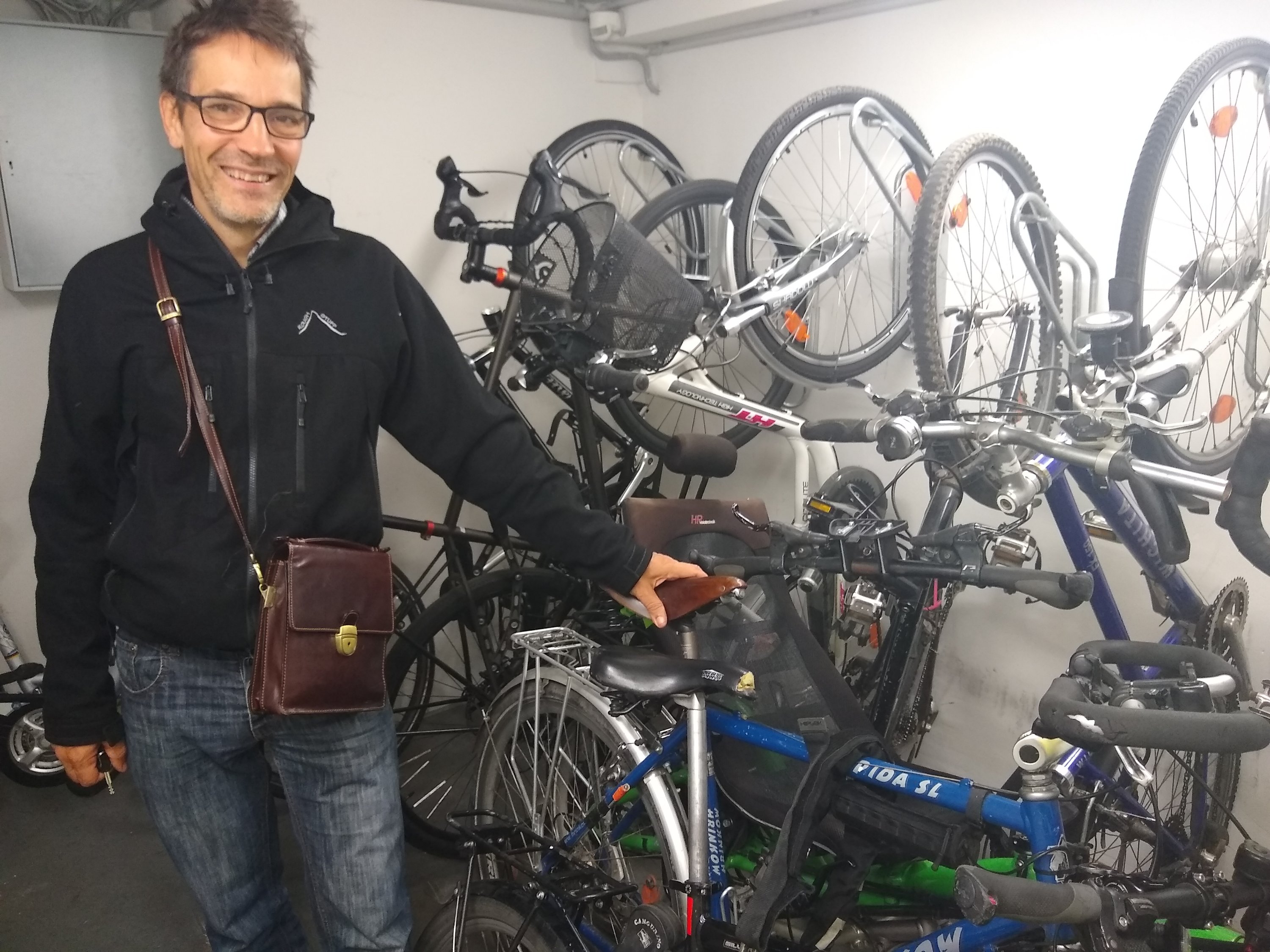
Stefan
Stefan, my host during my time in Vienna and a multiple bike owner himself, offered to let me test ride his folding Dahon, a small-wheeled versatile bike which can be adapted for touring and carrying luggage. I’m already familiar with the Alex Moultons and Bike Fridays of the small-wheeled world, but Dahon are a bit of a mystery.

Andreas with his Dahon
Then in the city centre I bumped into Andreas who was not only a proud owner of a Dahon, but had cleverly equipped it for the long distance stuff, and was a firm advocate for the nimble small-wheeled bicycle. With a quick flip of two levers, he folded it in seconds, and then demonstrated how he could detach the pedals with his fingers. As we parted company he shouted after me “Make sure you try out the Vitesse”. In fact, he was quite prepared there and then to let me test ride his own machine.

Staying with Stefan for a few days has brought me into contact with his other lodgers. He regularly hosts foreign exchange academics, and in this instance Kyoko is with him, a Japanese visiting fellow at Vienna university (whose mother Kaoro has come out to join her).
And Gudrun from Cologne, a university professor, who has recently co-authored a book about the rise of right wing populism in Europe,

came to Vienna to give a paper at a conference. I told her I hope one day to read her book in translation. “Well” she said “do you know anyone who might translate it for me?”. I’m afraid I can’t help you with that one, I said….now, if it were written in Spanish, we’d have a partnership…..
Stefan himself works in the offices of the Green Party in Vienna so, with so much political talent and involvement, there was a heavy bias in the conversation around the table…..and the table itself has been abundant with Japanese fare one evening, and Viennese another, amongst which was this delicious dessert called Kaisershmarm, anecdotally named after Kaiser Franz Joseph I, who was very fond of fluffy shredded pancake..

So tell me, what dish would you like named in your honour?
Bratislava to Vienna 80km
I’ve slept in a lot of strange places in the past, but never in a greenhouse. Erich, who runs a nursery garden business, decided to diversify, and converted one of his greenhouses into several AirB&B units….so his guests get to sleep in a glasshouse. But he kindly invited me, as a Warmshowers member, to stay as his guest, and my bedroom looked out onto the tomatoes, and I could lie in bed gazing up at the stars. My route to the bathroom was across a lawn on some stepping stones, and when I got up in the night, I jumped when the resident one-eyed cat scooted across my path, doing his security patrol.

Erich
The route to Vienna along the Danube fulfilled very few promises unfortunately. But I’ll let the pictures tell their own story….

The border with Austria, now without the former Iron Curtain checkpoints.

The Danube outside Bratislava

Monotonously straight, and I was still fighting a headwind

A huge variety of meadow flowers grow freely in the wetlands. Given that the river formed the border between east and west, the wetlands flourished undisturbed by human activity.

An autumnal greeting in Vienna

Towers and street food
The guy making me a coffee at his street bar said:”You don’t look like a normal tourist. You riding a bike?”. When I told him my story in one sentence, he said “You probably need a good strong coffee then. Going to Vienna after here? You’ll find us in Vienna too…look us up”.
Then I walked into an outlet advertising street food, and ordered myself a Morrocan tagine, to fuel the legs to climb the enormous hill to Hrad Castle where, amongst the many exhibits in the museum, was this….

Portable potty 19th C., made of walnut wood and porcelain
…and I thought, what an interesting use of the term ‘portable’. But a couple of cabinets away was a display of the first Bratislava Cycling Club founded in 1888, all lined up for the start of a race, and if you look carefully you’ll probably recognise one of them as being Peter Sagan’s great great grandfather….

There are towers to climb in Bratislava too. To get to the top of the Castle tower, you need a special kind of steely determination, and the Town Hall tower will reward you with lofty views over squares….

….and interesting roofs whose pitches make them look like church steeples…

And when you see some poor fellow trying to crawl out of a street drain, it is very tempting to just stroke him on the head to comfort him (as everyone does). What was he doing down there anyway?

And when you are bored with museums and towers and men crawling out of drains, you can join the crowds to catch bubbles, and contribute to this young man’s beer fund

…..believe me, people openly ask for money for their beer fund….they know you know they will spend the euro you give them on the next can of beer. So why not be honest about it….
Tomorrow, it’s goodbye Bratislava, hello Vienna…..with 60km of the Danube trail in between.
Bratislava: the false summit?
As my final destination, Bratislava was always going to be my second choice (behind Prague), but a persistent headwind across Poland dictated terms and conditions, so here I am, at the notional end of my journey.

But wait a minute, Vienna is only 60km away along the Danube, on Eurovelo 6. Flat, scenic and designed for cyclists, the only drawback being that I would be going upstream….. OK, not because it goes imperceptibly uphill (probably by only 10-20 metres), but because the vast majority of the annual 38,000 cyclists that follow the route go downstream, which is bound to complicate my progress if I have to go against the flow. But still….
Quite apart from the attraction of bagging yet another country and capital city, Vienna is a bigger transport hub than Bratislava, thus making it an obvious finishing point, with a greater chance of getting home by train and boat. Going overland will be more expensive than flying, and certainly more time consuming, but then I could simply change my thinking about that and regard it as part of the journey….in other words an integral segment of the whole adventure.

Last night, in the town of Pezinok, I was welcomed by an enthusiastic Slovak couple, called Michal and Eva, who are expecting their first baby in December. Michal came out to meet me on a borrowed electric mountain bike, one that he had been testing in the local hills, to see if he might be interested in one for himself.
The conversation over supper ranged from riding bikes to politics, and amongst the many fascinating (and disturbing) things I learned about Slovakia was the surprising popularity of its up-and-coming far right party, the Kotleba People’s Party, which has a double cross insignia that was used by an old Slovak fascist party during the war.

Slovakia spent more than 50 years subjected to the brutality of, first, the German Nazis, then the Soviet system, but people are clearly forgetting all that. The People’s Party ideology is underpinned by extreme nationalism, fundamental Christianity, hate for the Roma people, and a total rejection of western liberal democracy. What does that remind you of?
Tomorrow will be a day for exploring Bratislava.

Little Carpathian wine region
Now tell me, what do you know about Slovak wines…..never heard of them? If not, join the club. When did you last see a bottle of Slovak wine in your local supermarket? The reason why not is because the Slovaks keep it all for themselves. How selfish is that? But I’ve just discovered their dark little secret….in a wine museum in Pezinok, where I am spending the night.

For the ‘exorbitant’ fee of €3 (senior fee, of course), I was given a very informative audio guide to the excellent displays about the history and production of wine in Slovakia, and at the end I had a glass of the local Riesling thrust into my hand. Pity about the lack of pretzels….

The whole region, in fact, reminded me of the Alsace, and the vineyards growing along the slopes of the Vosges mountains. These vineyards grow on the slopes of the Little Carpathians, and the wines all have a similar character to the Alsatian wines…
I also learned about, and sampled, the first stage of production after the pressing, which produced what they translated into English as ‘the scrumpy’, a low alcohol beverage given to the vineyard workers as replacement for water….a bit like the small beer given to English farm workers in former times.

Last night, in Smolenice, I was hosted by an English family, resident in Slovakia for the last 6 years, and very happily settled. Mark and Suzanne’s 7 year old daughter, Zoe, was 1 when they arrived, so now has a native fluency in Slovak, and was proud to include their new kitten, Lily, in the photo.

The wedding march…
No, not the piece by Mendelssohn, but an actual march by real people. As I approached the village of Chetelnica, I could hear a band playing in the distance, and just imagined it was rehearsal day for the local musicians. However, when I dropped steeply down into the village centre, I met this very colourful procession walking along the road,

and right in the middle were the bride and groom. Lots of them shouted comments in my direction, which were either disparaging of my appearance or were an invitation to join the party…I’d like to think it was the latter.
About half of today’s 80km route was one of my favourite kinds of road, peppered with steep climbs, commanding views over the countryside, and tyre-burning descents….better known as ‘lumpy’ in the cycling community.

It also happened to be a favourite with that other biking community, the motorcyclists. Hundreds passed me, oblivious of the many shrines to the memory of their fellow bikers who have lost their lives on this stretch. And invariably, they ‘hunt’ in packs….they always roar past in groups…

Don’t be sad, I am smiling because at the moment (of the crash) I was happy. Vas Lubeno
So here are a few things that Slovakia is famous for: Peter Sagan, one of the most talented of elite cyclists, and certainly the most entertaining; the Slovak language has given us two very common words, ‘robot‘ and ‘pistol‘. And its capital, Bratislava, stands on the border of two other independent nations, Hungary and Austria. And don’t confuse Slovakia with Slovenia (which, apparently, many do) and in case you still haven’t caught up with history, it’s been separated from the Czech Republic since 1993. Here endeth the lesson….

Descending the Tatras
I was prepared for a long, fast descent….I knew it was on the menu for the day. However, Google maps couldn’t provide a cycling option in Slovakia, the only option that gives an elevation profile of the route ahead, so I used the ‘terrain’ format to help identify ascents and descents.
Before the continuous fast stuff started, there was a switching of valleys, which meant another horrendously steep climb up and over, but once that was out of the way, after a 15km fast descent, there was continuous gradual descending for the rest of the day.

Beginning of 15km fast descent
After 110km, I got to Trencin an hour before dark, to find the only campsite had closed for the winter 4 days ago, and every hotel and hostel I contacted or visited was either full or closed. This created a predicament that required a bit of creative thinking and a strong coffee.
So I decided to wait for dark and do a stealth pitch of my tent, but then chanced by a service station, and went in to have a coffee and consider my options. The girl behind the counter spoke good English, so I enlisted her support…. Between serving customers and checking the internet, she kindly made a few calls for me and eventually found a vacancy in a penzión just three doors away.

What I ended up with (despite its unpromising name) was a suite of two bedrooms, a kitchenette and bathroom for a very reasonable €30…..and he let me sleep with my bicycle….🤩
Having dropped from the high Tatras, I am now in an entirely different climate zone. The layers came off gradually as I lost altitude, from a few degrees above freezing, I ended up in a relatively balmy 18C.

Slovakia: 7th border incursion
I am the luckiest guy in Slovakia (well, now that I’m here). As I began the long, arduous climb up to the border, there were several occasions when the weather threatened my progress. But, despite all the threats and icy cold showers, I persisted, climbed over the border (topping out at 700 metres, 2,300ft) and hurtled down the other side into the town of Cadca, when the heavens opened, and the temperature immediately dropped some 10 degrees….the day ended icily cold…..I mean icily cold. That’s why I am the luckiest guy…..I could easily have been caught by that at the highest point of the ride, totally exposed, no shelter…it simply doesn’t bear thinking about.
So I grabbed myself a 15 euro room, and have just munched my way through the biggest pizza I’ve ever eaten in my life…

But I will let the pictures of the day tell their own story…

This chap was foraging for mushrooms in the forest

Smoke from chimneys tells you something about the temperatures in the mountains…the smell reminded me of my childhood

Fuel for the final push

The final of three stretches at 25% incline….and no, I didn’t ride them… I’ve finally accepted I’m no longer a testosterone-driven 30 year old

I proudly present to you the official border separating Poland from Slovakia

…and if that isn’t enough, here is proof from Googlemaps

2,300 feet above sea level

And so into the Tatras…
Ah, hello dear friends! How I’ve missed you….
No not you, the mountains…. After nearly 1,900km of mostly flat, sometimes dispiriting, riding against a predictable headwind across 6 countries, I can’t begin to explain the sheer relief I felt at finding myself in the foothills of the Tatra Mountains (also known as the Little Carpathians). I’m currently only 50km from the border with Slovakia, my 7th country on this trip…..but more of that later.

Adam rode with me through the city on his way to work
Special mention must be made of my Warmshowers host over the last two nights in Krakow. Adam is a veteran of road and off-road riding, with many years of touring experience, covering some 10 countries in the Balkans, and cycling from Poland to Nordcapp, over 5000km, to the most northerly point of Norway (and Europe). These are just two of his many exploits, all of which have been recorded on film, and we spent several hours reliving those experiences. I was mesmerised by the quality of his filming and the landscapes he has travelled through. Click here to sample some of his offerings. Sit back and enjoy them, whether or not you are a cyclist. You will be carried along by the gentle quest to discover new landscapes.

Benedictine Abbey at Tyniec
Back to my own journey. As I cruised out of Krakow on dedicated cycle paths, and had begun to climb up from the valley of the River Vistula, I chanced by the oldest Benedictine monastery in Poland, sitting high above the river,

and enveloped in that sense of withdrawal from life that begs you to stay awhile. A Dutch lady I met at the entrance was an habitual visitor, drawn back to Poland year after year.
After 102km, in the late afternoon, I checked into a wayside room, just into the final climb of this segment…

and at some 400 metres above sea level, I decided the night time temperature would be way below the tolerance of my sleeping bag. So once again, the indulgence of a real bed and a chef-prepared meal…..what has happened to the spirit of austerity, you might ask.

Time hath no power over me..
…or so I thought. I learned the full force of Polish steely determination when I cycled out to visit the Oskar Schindler Enamel Factory, about 3km out of the centre of Krakow. It was a free entry day and it closed at 16.00. As I negotiated a very tricky route I found a road closure, which sent me on a longish detour. I arrived at precisely 14.35, only to be told the last entry was at 14.30 (because, apparently, you absolutely need 90 minutes to see the permanent exhibition).

“But….but…..but I’ve cycled here, and been delayed by a road closure, and the website said nothing of the last entry at 14.30…..can’t you make just this one exception?”
I won’t bore you with the detail, but I tried various ploys to blag my way in…..I even tried walking past the entrance staff to see if they would notice….even if I’d been Pope Francis himself, they would have barred my way through. So just being any old ‘Francis’ wasn’t going to cut it either….. I’ve now learned the hard way…. don’t mess with Polish museum staff.
But I do love browsing museums, learning about the history of places and their principal characters and, of course, every city will highlight its own positives:
Had there not been a Rome in Italy, Krakow itself would have been Rome.
Wawel Castle, on the top of the hill, is the most beautiful in the country..
But Krakow, like the rest of Poland, suffered disastrously at the hands of, first the Gestapo, then the Soviet KGB….go to the Terror of Krakow exhibition and you’ll need a strong coffee afterwards to calm your nerves.
But then spend an hour in the National Museum to discover Polish works of art of the 19th century, and you’ll come across jewels like this by Jacek Malczewski…

If Gothic and Baroque is your thing, there are more visitable churches than you can shake a stick at. If you need to help purge the demons of the holocaust, go to Auschwitz, or dally in the Jewish quarter of the city and visit the old Synagogue.

Krakow Market Square
Tomorrow I resume my battle with the headwind in search of the foothills of the Tatra mountains, the most westerly peaks of the Carpathian mountain chain. After some 1800km on this journey, the legs will get their first stretch in hill climbing, to give me my first elevated views of landscape.
Two Krakow encounters..
Tent dried from the overnight dew and packed up, I headed for breakfast in a nearby café, and just about managed to eat one of their small Polish-style hotdogs, but then in came this ‘Uber-Eats’ delivery guy, and he gave me a quick lesson on how to eat two giant-sized ones in quick succession…..and in less than two minutes!

Then later in the day, as I took shelter from the rain, Peter Lee (his English name of course) from Nanjing in China, struck up conversation in almost flawless English, and ended up showing me some of his superb photography shot on his most recent trip to Tibet. He then told me of his upcoming trip back to Tibet, and the 6 week 20,000km journey he will do with a friend in his car, and I ask him: ‘what has happened to the bicycle in China?’.
He looks at me and gives me one of those inscrutable Asian smiles, and proudly says: ‘Ah yes, the bicycle….China has changed a lot….we now have real traffic jams…’


 LIFE AWHEEL